Towing
Flatbed towing
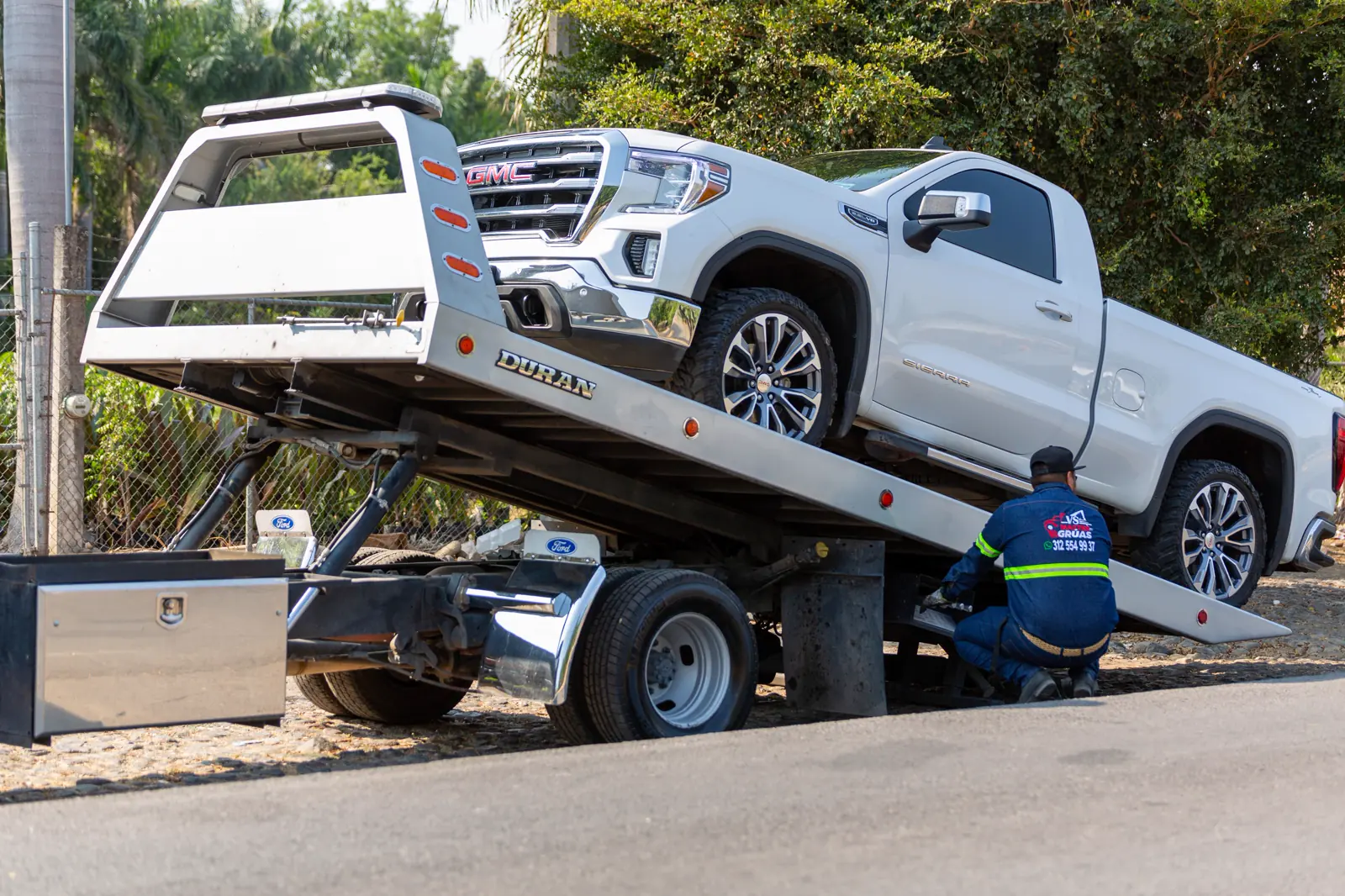
The whole vehicle rides on the deck. Nothing drags, nothing rolls, no driven wheel turns on the way.
When does a car need a flatbed tow instead of a normal tow?
A flatbed carries the entire vehicle on its deck with all four wheels off the ground. It is required when any wheel cannot safely roll or turn: all-wheel-drive and four-wheel-drive vehicles, cars with wheel, axle, suspension or steering damage, vehicles that will not shift into neutral, lowered or low-clearance vehicles, and anything already on its side. Julius Towing operates flatbed equipment across East Point, College Park, Hapeville and metro Atlanta, 24 hours a day.
People ask for "a flatbed" the way they ask for a brand name, and often they are right to. But it is worth knowing why, because it also tells you when you do not need one — and a flatbed is not always the cheaper or faster option.
When a flatbed is the right call
- All-wheel drive and four-wheel drive. On most of these, the wheels are mechanically linked. Towing with one axle on the ground spins the driveline while the vehicle is off, which can damage a transfer case or differential. All four wheels come up.
- Wheel, axle, suspension or steering damage. If a wheel will not roll straight — or at all — dragging it is not an option.
- Lowered, modified or low-clearance vehicles. Approach angle is everything. This wants a deck that tilts and a driver who has done it before.
- It will not go into neutral. Dead battery, locked column, no keys, seized transmission — all the same answer.
- Non-runners, project cars and long distance. Nothing wearing out on the trip.
- After a collision. Frequently the only safe way to move the vehicle without adding damage to it.
When you probably don't need one
A healthy front-wheel-drive car with four good wheels, rolling freely and shifting into neutral, is a perfectly correct wheel-lift job. And in a parking deck, it is the only job — a flatbed will not fit under a six-and-a-half-foot clearance bar. Asking for a flatbed in a deck means the truck arrives, cannot enter, and everyone starts again.
Tell us the vehicle and where it is sitting. We will tell you which truck it needs.
Questions people actually ask
Is a flatbed more expensive?
Not automatically. Price is driven by distance and the difficulty of the job rather than the truck type alone. Where cost genuinely rises is when the situation is harder — a winch-out, an awkward load, a vehicle that cannot roll — and those are the same situations that call for a flatbed in the first place.
Can a flatbed get into my apartment complex?
Sometimes. A flatbed needs length and a straight approach to tilt the deck. Tight lots, speed bumps and low branches all matter. If you know it is tight, say so and we will bring the wheel-lift instead — it is not a downgrade, it is the correct tool.
Will my car be damaged going up the ramp?
Not when it is done properly. Low-clearance vehicles get ramps or boards under the approach; the tie-down points are chosen for the vehicle rather than whatever is convenient. If your car is lowered or has an aggressive front lip, say so on the phone — that one sentence prevents the most common way tow damage happens.
Tell us where you are.
Dispatch answers, gets your location, and tells you what happens next.